A Forest Fire at Sea – the USS Forrestal

When we record episodes of the Airplane Geeks the format is usually the same. We introduce our guest, when we have one, and then run through the four or five major aviation stories of the past week. Max and Micah and David and I offer up our opinions about the importance of the items to the grand scheme of the aviation industry. If you listen, you get that.
And then, right near the end, we set aside a couple of minutes to mention some side project one of us is working on that might be of interest to our listeners.
Last week only Our Maine Man, Micah had anything to share. My eyes narrowed a bit though when I read our show plan that said his story was about an aircraft carrier, USS Forrestal.
What? The show’s supposed to be about airplanes.
Anyway, out of respect for my co-host, I waited for the piece to play through before commenting.
Holy smokes.
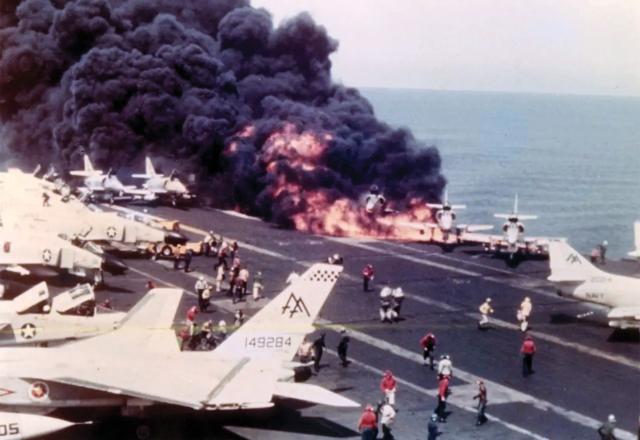
Micah told us about the catastrophic fire aboard the USS Forrestal in June of 1967 when it was anchored off the coast of Viet Nam.
His story ran maybe 10 or 12 minutes. Honestly I was so mesmerized by the details of the mess aboard the ship that I lost track of the time. Micah wove the tail of the once great carrier that, if it had been a book, I wouldn’t have wanted to put down. there’s even a mention of the late American Naval here, Senator John McCain.
I’d like to share Micah’s story with you now. Trust me. It’s worth the listen.
Rob
________________________________________________________________________________
A Forrest Fire at Sea: The USS Forrestal
By Micah Engber
It’s funny how things go sometimes. It was Veteran’s Day 2025 and I was driving to get my coffee at my usual place, a gas station in South Portland. Now don’t laugh at me about gas station coffee. This place has machines that grind the beans fresh and then makes a great pour-over cup of coffee for about a quarter of the price that I would pay at one of the big name coffee shops. Just about any time I want a cup of coffee, or a fountain soda, this is where I go. I’m a regular there, and it’s nice to have a place with a local feel to it.
Anyway it was Veteran’s Day and as I was driving to get my coffee I was thinking about how I haven’t written a story for the Airplane Geeks in a long time. I’ve written stories for Veteran’s Day or Memorial Day in the past. They’ve been aired here, or on The Airline Pilot Guy podcast and occasionally even published by Jetwhine. (You know what I always say about Jetwhine, there’s some truly superb writing there, and a few pieces from me.) But I haven’t written anything at all in a long time.
You see, I tend to be an inspirational writer. No. I don’t mean that I inspire my audience, what I mean is, I write inspirationally, not perspirationally. Although I can do it, I have a hard time writing on demand; I need to have something to motivate me to tell a story. I hadn’t had that in a while and that was what I was thinking about on the way down to the gas station for my coffee.
So I pull into the station and stop behind another car in a two pump line. The car in front of me was a small red hatchback, nothing remarkable about it at all, but then I noticed a small round sticker on the lower left side of the lift gate. It read USS Forrestal.
I got out of my car to go inside to get my coffee when the owner of the red car comes out and begins filling it with petrol. He looked ten to fifteen years older than me, tall, thin, and a bit grizzly. But that grizzledness didn’t stop me. I said “Pardon me Sir, did you serve on the Forrestal?” “Yes I did” he said, “What do you know about it?” “A few things” I responded, “but mostly about the fire.” He asked me “Which one?” and I said, “The one off the coast of Vietnam.” His face changed as I said that, he replied “I was there, fresh out of boot.”
I was astonished; I was actually speaking with someone who was on board the USS Forrestal during that fire. What were the chances? And on Veteran’s Day! I told him that this was a part of history that many people seem to have forgotten. I introduced myself as a co-host on the Airplane Geeks and asked him if he might be willing to be interviewed for the show. He seemed to be taken aback and just said “I don’t like to talk about it.”
I understood what he meant, and appreciated that he spoke with me about it as much as he did. I thanked him for his service, shook his hand, and went inside for my coffee. But there I was, talking to an old man, even older than me, who some 60 or so years ago, when he couldn’t have been more than 19 years old was part of one of the biggest carrier disasters in US Naval History.
Let me tell you a little about the USS Forrestal. She was the lead ship in her class, the first of the “supercarriers” and the first designed from the beginning to have an angled flight deck and steam catapult, both British innovations. She was also the first to be built with an optical landing system. All preceding carriers were modified with those systems, as opposed to being designed with them in the planning stage. The USS Forrestal was just a bit smaller than the current Nimitz class of carriers and powered by 4 Westinghouse geared steam turbines through 8 Babcock & Wilcox oil fired boilers. She was a monster for her time. Through her career her decks handled the A-3 B, A-4, A-5, A-6, A-7, F-4, F-14, E-2, EA-6B, C-2, S-3B, SH-3, and the KC-130. Yes, you heard me, the KC-130.
In November 1963, over the course of three days, Lieutenant James H. Flatley III along with his crew, made 21 full-stop landings and takeoffs in a C-130 Hercules aboard the USS Forrestal. You can find some of them on YouTube and see for yourself if you don’t believe me.
At the time, the Navy was trying to determine if the C-130 could serve as what they called a “Super-COD”, “COD” for carrier onboard delivery” aircraft. No other plane could replenish a carrier in mid-ocean. It turned out that even without an arresting hook or a catapult takeoff flying a C-130 on and off a carrier worked, it was successful, but there was a slight issue. The C-130 Hercules was too big to fit on the carrier’s elevators or in her hangars for that matter. This is why we have the C-2 Greyhound, which is only recently in its retirement phase. And by the way, Lieutenant Flatley was awarded the Distinguished Flying Cross for those carrier flights, and the C-130 he used is on display at the National Naval Aviation Museum at Naval Air Station Pensacola.
There’s a kind of an interesting story about an F-4 Phantom II that involved the Forrestal. I’m not sure how often something like this happens, but if and when it does, the general public typically doesn’t learn about it until years later.
From August 1962 though March 1963 the USS Forrestal was on a Mediterranean deployment and participating in a large NATO exercise along with the USS Enterprise a French carrier and the British HMS Ark Royal. For part of the time the Forrestal was performing cross deck operations with the Ark Royal. Aircraft from the Ark Royal would land on the Forrestal and vice versa. Well at one point while a US Marine F-4 Phantom was on board the Ark Royal, developed some issues and couldn’t return to base on the Forrestal. The Ark Royal was due to dock in Malta and at the time US Armed Forces personnel were not allowed on the island. But being so well versed and crafty in carrier operations, the Brits painted the US Phantom in Royal Navy tail markings so it would blend in the their own F-4s and not cause an international incident.
Earlier on, I mentioned a fire; actually there were several of them. The USS Forrestal was often referred to as the “USS Zippo”, the “Forrest Fire” or “Firestal. She had a lot of fires over her career.
 In 1972, while moored in Norfolk, the Forrestal was the scene of a catastrophic fire set by a crewman. In January 1978 a fire started when one A-7 Corsair II crashed on the flight deck and hit another A-7 as well as an EA-6B Prowler. In April of 1978 some freshly painted thermal insulation in the main engine room started to smolder set off by hot steam lines and three days later, there was another fire in the catapult steam trunk and storeroom. Then, on October 9, 1989 a fire caused some major damage to a primary command and control trunk space.
But the big fire, the one that resonates in history and the one I spoke of with the man at the gas station was in June 1967. Now there’s no way I can cover all of this, there are just too many details, but just like we talk about when discussing an aircraft incident, the Swiss cheese model comes into play. All the holes line up, and that’s when an accident happens.
The Forrestal was in the Gulf of Tonkin preparing for the second sortie of the day. The aft portion of the flight deck was filled with aircraft being readied for the next mission, all of them fully loaded with bombs, rockets, ammunition and fuel. At 10:51 AM, when an F-4 was switching from external to internal power, it set off an electrical surge that launched a Zuni rocket from under its wing. Now Zuni rockets all have a safety pin to keep them from launching while on deck. They’re supposed to be removed just before catapult launch, but for some reason this pin wasn’t in place.
The rocket flew across the flight deck, severing the arm of a crewman, and ruptured a 400 gallon external fuel tank on an A-4 Skyhawk. It’s still in dispute as to whether this was John McCain’s aircraft or his wingman’s. Although the ordinance on the rocket didn’t detonate, it did set off a massive fire in the spilled fuel. Fragments of the rocket punctured another fuel tank and the fire was fed by a 32 knot wind coming across the deck. You see the Forrestal was turned into the wind readying for a launch.
But it gets worse! Because of a shortage of modern bombs that use Composition H6 as the explosive, the Forrestal had been supplied with older bombs that used Composition B, a much more unstable product. Also, these bombs had a thinner skin, and being old the Comp B had deteriorated, and many of the bombs were seen leaking.
The damage control team worked fast and the Chief, without even stopping to don protective gear, started to spray down the fire to give the A-4 pilots a chance to escape from their planes. Then he set to work to try to cool down a bomb that had dislodged from one of the A-4s so it wouldn’t cook off. But in just 96 seconds, that first bomb exploded. Thirty-five personnel were in close proximity to the blast. Two hose teams were decimated, twenty-seven men were injured, including John McCain who was hit by shrapnel.
The bomb blew a crater in the armored flight deck and burning fuel poured through into occupied berthing compartments below. On deck all the F-4s caught fire and two more thousand pound bombs went off, eight more would explode before the end of the day. It was surmised that these Composition B bombs were as much as 50% more powerful than a standard 1,000-pound bomb, because this old Composition B was so badly degraded.
A 750-pound bomb, a 500-pounder and a number of missile and rocket warheads exploded. The port quarter of the flight deck was gone. Forty thousand gallons of burning jet fuel from ruptured tanks poured across the deck and flowed through holes into the aft hangar bay and berthing compartments. Explosions and fire killed 50 crew members, scheduled for night duties that were sleeping in their bunks below the aft portion of the flight deck. Forty-one more crew members were killed in other internal compartments of Forrestal.
In what was described as an act of magnificent seamanship, the destroyer, USS Rupertus, maneuvered as close as 20 feet from the Forrestal for 90 minutes, directing her own on-board fire hoses at the burning flight and hangar deck to try to get the fire under control. Crewmen crawled through the burning flight deck and hangar decks to work to defuse bombs that were smoking. After more than 17 hours of firefighting, at 4:00 AM the next day, the fires were declared out.
Four days later the Forrestal sailed into Naval Air Station Cubi Point in the Philippines. She was repaired just enough to be made seaworthy so she could return to the USA for a full refit. But during base welcoming ceremonies in the Philippines, a fire alarm went off that alerted crews to a mattresses fire in one of the compartments.
She departed the Philippines on August 11, and a month later arrived at Naval Station Mayport in Florida to disembark the remaining aircraft and air group personnel. Two days later she was in Norfolk. Full repairs were completed by April 1968 at a cost of 72 million dollars, close to 720 million in today’s dollars. She went on from there to continue her illustrious career.
The Forrestal served until 1993 when she was decommissioned. There was talk of preserving her as a museum ship, but that fell through. After about 20 years of negotiation and decision making, the Forrestal was eventually towed to Brownsville, Texas where she was scrapped.
But the USS Forrestal still lives on. After being decommissioned her two 30 ton anchors were transferred to the USS John C. Stennis, and her four nearly new bronze propellers were installed on USS Harry S. Truman that was still under construction at the time.
And while the USS Forrestal had an amazing and storied 38 year career, it’s mostly the 1967 fire that’s remembered today. And in thinking back to my brief conversation with one of her crew at the gas station, who some 58 years ago, was an 18 or 19 year old new boot on his first ship at the time of the big fire, I can understand why he doesn’t like to talk about it. But when I think of him, I try to remember, we have heroes in our midst.
For the Airplane Geeks and Jetwhine, here in Portland, Maine,
This is your Main(e) man,
Micah

There’s More to Flight Instructing Than Simply Logging Hours