ATC Overtime; FAA & Controller Perspectives
Never in my quietest moments did I imagine the conversation about FAA and its overtime policy was going to erupt into such a round of air rage of sorts. Luckily only a few of the hostile words were directed at me personally. But the passion of the respondents here cannot be ignored, nor the fact that the level of controller anger is rising.
 Last week I questioned why both the FAA and the GAO were publishing information that claimed controllers were volunteering for overtime at the same moment NATCA was on the Hill trying to convince Congress there are too few controllers and most are exhausted.
Thanks to all of you who chimed in.
We’re trying a bit of a point, counter-point today with input from FAA and a letter from a Denver controller that, for me at least, explains the controversy better than I or most of the experts.
First an update from FAA.
Laura Brown, FAA’s Deputy Asst. Administrator for Public Affairs offered comments that shed some light on how the agency sees this overtime issue.
The first question I asked Laura was in response to use of the term volunteer … “If controllers are volunteering, they’re volunteering,” I said. “But dozens of FAA people tell me that facility managers have added a mandatory meaning to the definition of the volunteer moniker.”
Brown: “Most of the air traffic facilities have “volunteer” lists because there are many controllers who actually want to work overtime. At some facilities, NATCA officials have encouraged their members not to volunteer for overtime.
Here’s what makes this complicated: when a manager schedules overtime and takes someone from the volunteer list, and they are now scheduled to work the overtime, is that mandatory or voluntary, since it’s scheduled? Union officials would argue that’s mandatory, since it’s scheduled. We’d argue that the controller volunteered to work, so it’s voluntary.
“Also, if they use up up everyone on the volunteer list and schedule someone who has not volunteered, but the opportunity exists to swap schedules, is that mandatory? It comes down to perspective and the perspective in some facilities is much different than in others.”
Jetwhine: “People tell me they have communicated very clearly to their managers that they absolutely do NOT want OT. But, if they answer their phone on their day off they’re stuck. Would that be correct?
So does the agency have the right to call someone on the Do Not Call list and tell them they must work? And if the OT is scheduled by the manager, even for people who have said they don’t want it, I’m having trouble understanding how that can be anything like voluntary.
But maybe I’m missing something.”
Brown: “There is no such thing as a Do Not Call list. When controllers are hired, it’s clear that they may be asked to work overtime, whether or not they want to. The situation you described would be mandatory overtime, yes. As I understand it, the vast majority of overtime does not fall into that category.”
Why They Work
I’d like to show you a letter I received from a controller who made the point very clearly about why, despite the confusion with terms and policies, our ATC system continues to function.
“One of the personality traits that air traffic controllers share is the ‘I can make anything work / I can fix anything’ mentality,” Center controller Dan Lage said. “We are not going to let our companions work understaffed with little or no breaks in their workday because the FAA has arbitrarily reduced staffing levels while air traffic numbers are soaring. Denver Center’s traffic has almost doubled in the last 20 years, but we are working with about the same, or maybe fewer, number of controllers we had in 1988. We know what it is like to be swimming in airplanes for 3 hours without an offer of a break, or struggle to get miles in trail restrictions for overburdened airports or airspace.
“We may be tired but we are not going to leave or companions high and dry,” Lage added. “We will offer ourselves to the point of exhaustion to help each other. We constantly are having to make up for managements misjudgments and make faulty equipment and software work. We will carry on until we are driven literally into the ground. We can’t help it. It is ingrained into our personalities.”
Down the Road
I have asked Laura Brown for a look at the agency’s review of the amount of overtime used in the past few years, as well as what kind of dollar figure that represents. I’ll post something as soon as I receive her response. Perhaps that will answer the question of not simply how much overtime is being consumed, but why the agency doesn’t seem to be as concerned about the issue as the people doing the work.
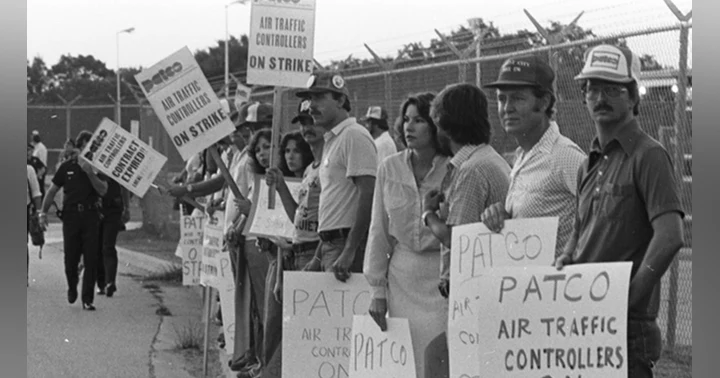
ATC: 45 Years After the PATCO Strike